FIRST NAME OF CHARACTERS IN CvS MOVIES
ASHLEY, CHRISTY, ELIZABETH, TRISH
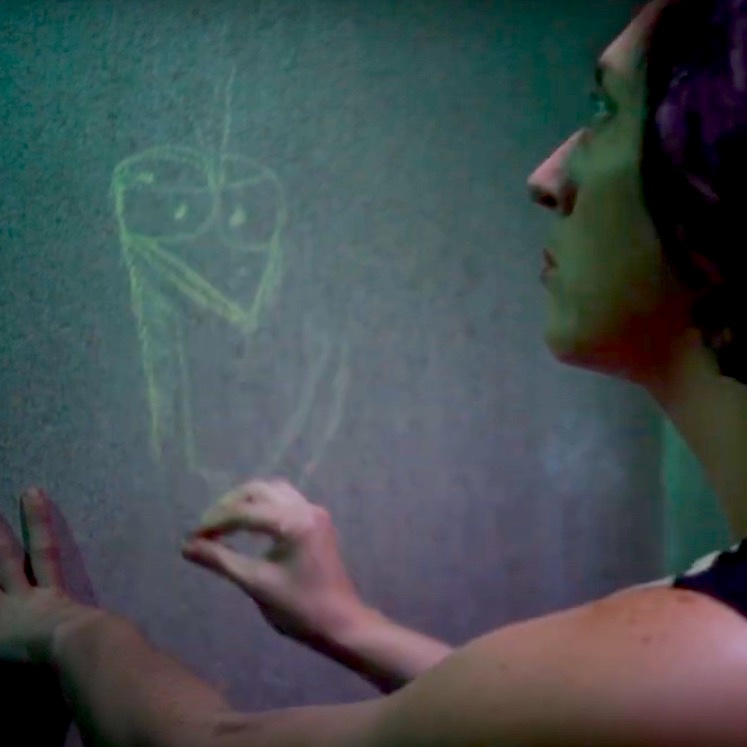
ASHLEY Bakerson is a cartoonist looking to “draw in” a new love interest after breaking up with her cycling-obsessed boyfriend in Chickens vs Sputnik’s 2018 production The Deal Breaker. In the frame capture below, Ashley’s looking smitten with her date, but this is before she learns he owns bicycles.

CHRISTY Nattingly, played wonderfully by Haven, was the daydreaming, crime-solving hotel worker in The Yegg, produced by CvS in 2022.

CvS’s 2023 production Monsters and Mavens featured badass marine-life scientist (not marine biologist) ELIZABETH Vanterbus. Elizabeth (portrayed by Amber), uses a process of elimination to guide her while dancing and splashing through her search for the unidentified marine specimen washed up on a Rhode Island beach.

In 2024 CvS presented TRISH Gofursh as the bi-continental protagonist in their production Reflecting Across the Pond. Rebecca Reardon (left, below) from Hebden Bridge, UK portrayed the mature, ever-contemplative Trish on that side of the pond while Piper played young Trish stateside.

NOT Chickens vs Sputnik, I know, but I’m including this extra info about another 48-hour movie team headed up by a family member. Jay’s team only used the same gendered-name option as the CvS team in one of the four production years outlined above.
JAY’S TEAMS (VARIOUS NAMES)
YEAR
GENRE
TITLE
CHARACTER NAME
2018
HORROR
So Close
ASHLEY Bakerson
2022
CRIME/
COMING OF AGE
Grand Theft
Uh Ho!
Chris Nattingly
2023
ROMANCE
Felt Cute (might delete later)
Edward Vanterbus
2024
HORROR/
CLIMATE
The Planner
Trevor Gofursh
ASHLEY BAKERSON

CHRIS NATTINGLY

EDWARD VANTERBUS

TREAVOR GOFURSH
OTHER NAMES WE CONSIDERED FOR OUR KIDS
EMILY, MARY, PHOEBE, LOTTIE
Silly grouping, I know, but I needed a grouping of just first names. I admit we may be looking at a repeat of the Aloha Pie situation here with me misremembering things. If I do remember correctly, when Norma was pregnant with Rick, she had considered the name EMILY. MARY was in contention when Jan was pregnant with Mike, and Sarah considered PHOEBE for a while when pregnant with Megan.
Catherine’s name wasn’t decided upon until days before her birth and I held out for a while for the name LOTTIE. I just really like the name and there’s an interesting story about me learning that Jim — before I even knew him — knew of my dad’s Aunt Lottie.
I overheard Jim telling a story to friend about the Swamp Yankee that ran the general store in Shannock.
Apparently, another friend of Jim’s stopped at Lottie’s store to grab the Sunday newspaper. The friend was told that while, yes, she (Lottie) had a pile of newspapers behind the counter, she could not sell him one at that moment lest she disturb the sleeping cat (curled up atop the papers). Lottie asked for the man’s telephone number and told him she’d give him a call when the cat woke up and moved on, allowing her to access the papers once again.
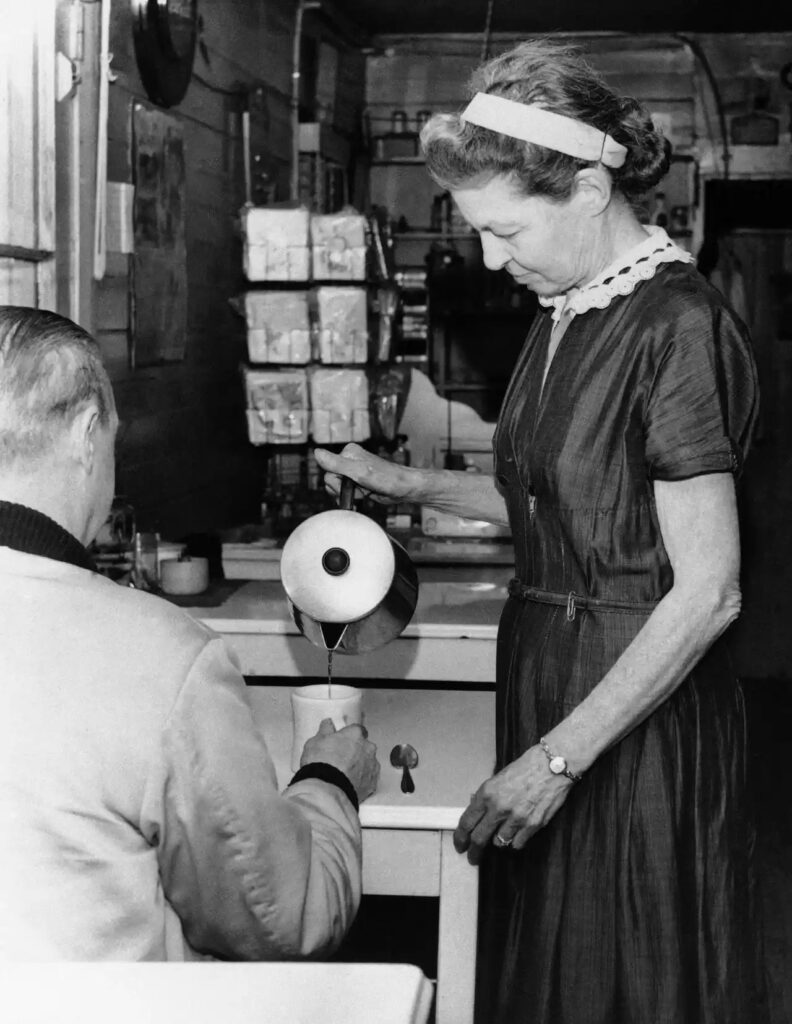
LOTTIE WHITING SERVING COFFEE
TO A CUSTOMER AT WHITING’S
COUNTRY STORE – DECEMBER 1964
I was slack-jawed by the fact that Jim knew of Lottie. I quickly realized he had probably even been in the store given the amount of canoeing he had done in and around Shannock. I was very much humored by the story. Ultimately Jim nixed the name Lottie assuming it would be shortened to “Lott” making the full name, Lott Knott…apparently I’m not the only one in the family that doesn’t like rhyming names.
A footnote about the photo of Lottie used here. It’s from a 2017 posting in the Denver Post. I know, so weird! The photo is part of a Today in History photo collection. The text that accompanied the photo is as follows:
Lottie Whiting pours a cup of coffee for a customer at
DENVER POST
Whiting’s Country Store in Shannock, Rhode Island, Dec. 22, 1964,
operated by her and her husband George. They have been charging
five cents a cup for the last 35 years. Lottie wouldn’t think of
boosting the price even in the face of the mounting cost of
operation. She said “This is our lead item. It brings the people in.”
Yes, people were flocking to Shannock for that five-cent coffee!
FAMILY EDUCATORS
SARAH, MEGAN J, JAN, ESTHER
SARAH (in yellow in the photo below) got a master’s degree from Sacred Heart University while she was living in New York. I’ve tried to get as many specifics as I can for these postings, but I can’t say exactly what her degree is, but it is some form of a teaching degree. She’s worked for the City of Providence for nearly 20 years at the Museum of Natural History in Roger Williams Park as a museum educator. Shout out to Renee Gamba for providing a photo.
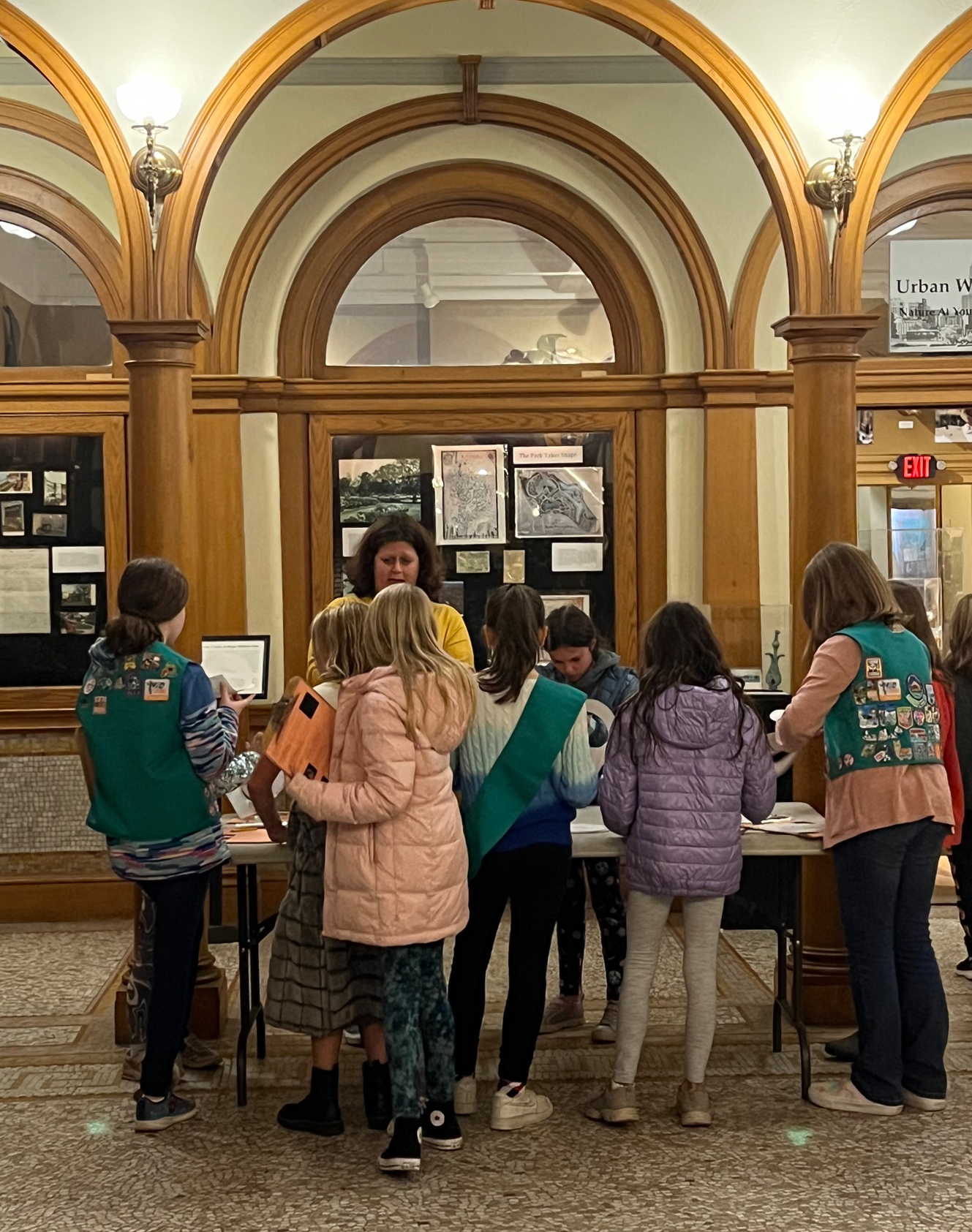
SARAH RUNNING AN EDUCATION PROGRAM for
girl scouts AT THE MUSEUM OF NATURAL HISTORY
AT ROGER WILLIAMS PARK IN PROVIDENCE
MEGAN J completed her degree in math education at Rhode Island College in 2007. She taught in Coventry schools for three years before eventually opening Anchor Gymnastics in 2014, where I’d argue she continues to teach. It may officially be called coaching in the gym environment, but I’d say she’s expertly teaching (among all the other things she does there related to running the business) a myriad of skills and know-how.
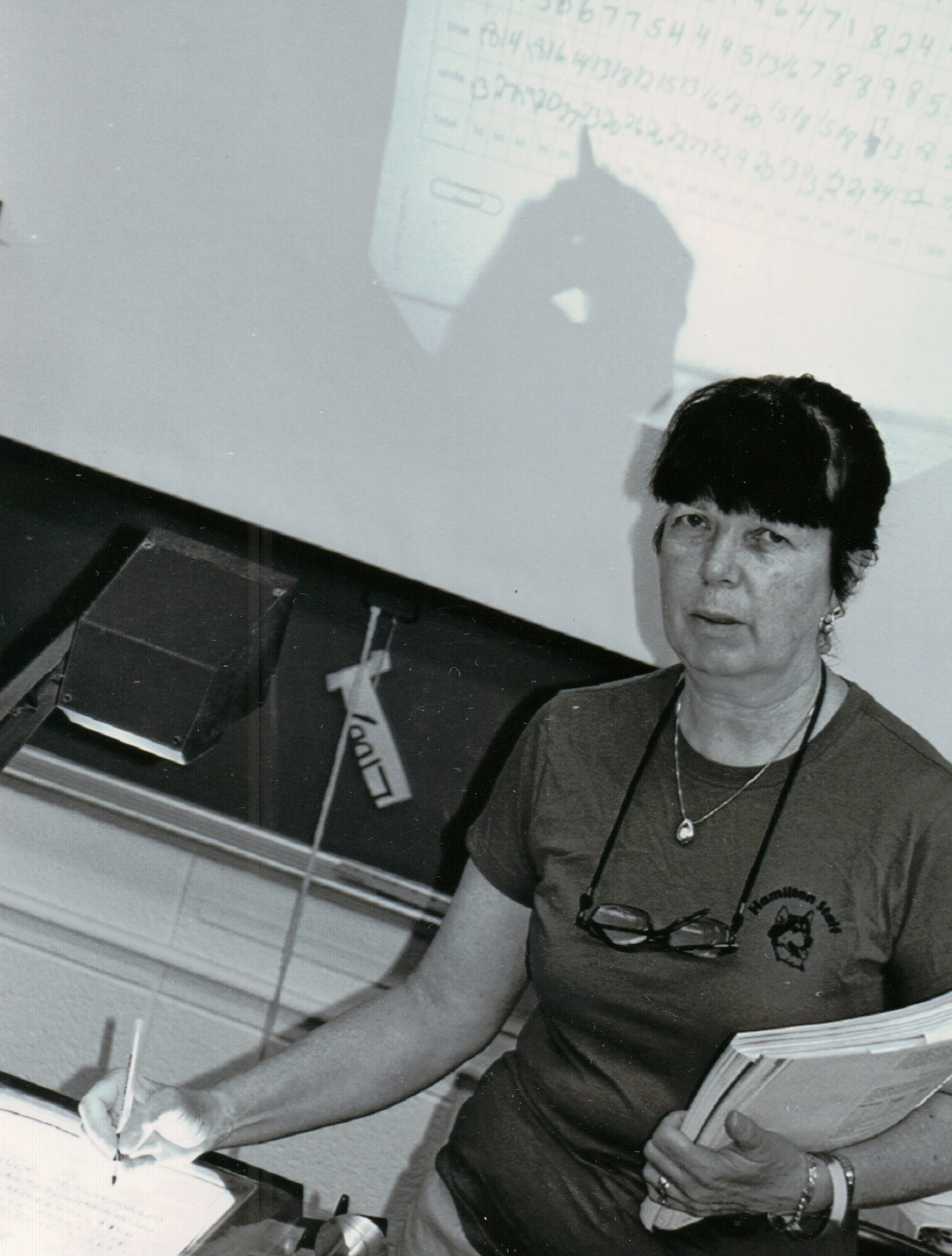
After completing a degree in elementary education at the University of Rhode Island, JAN taught at three North Kingstown elementary schools (Quidnessett, Wickford, Hamilton) over the course of her career. She subbed in Hawaii and most recently has volunteered in schools in Massachusetts and Rhode Island. The picture to the left was taken when she was teaching at Hamilton Elementary near the end of her career.
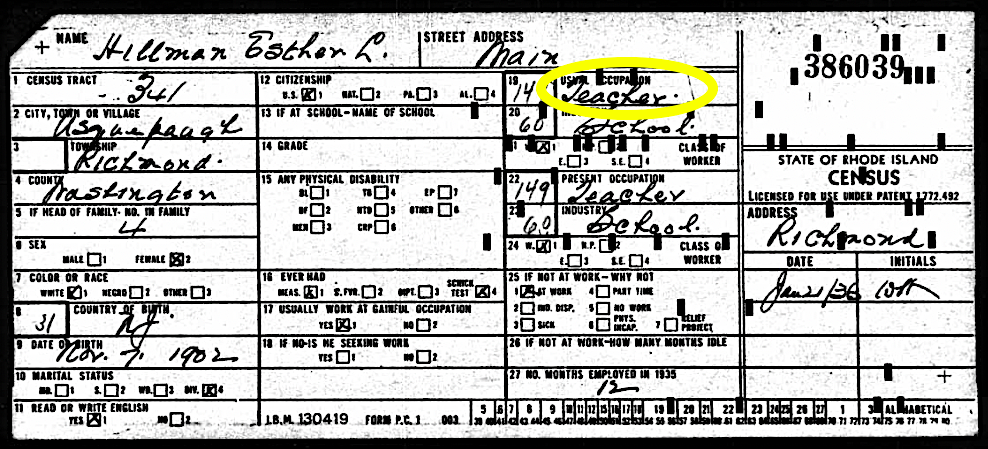
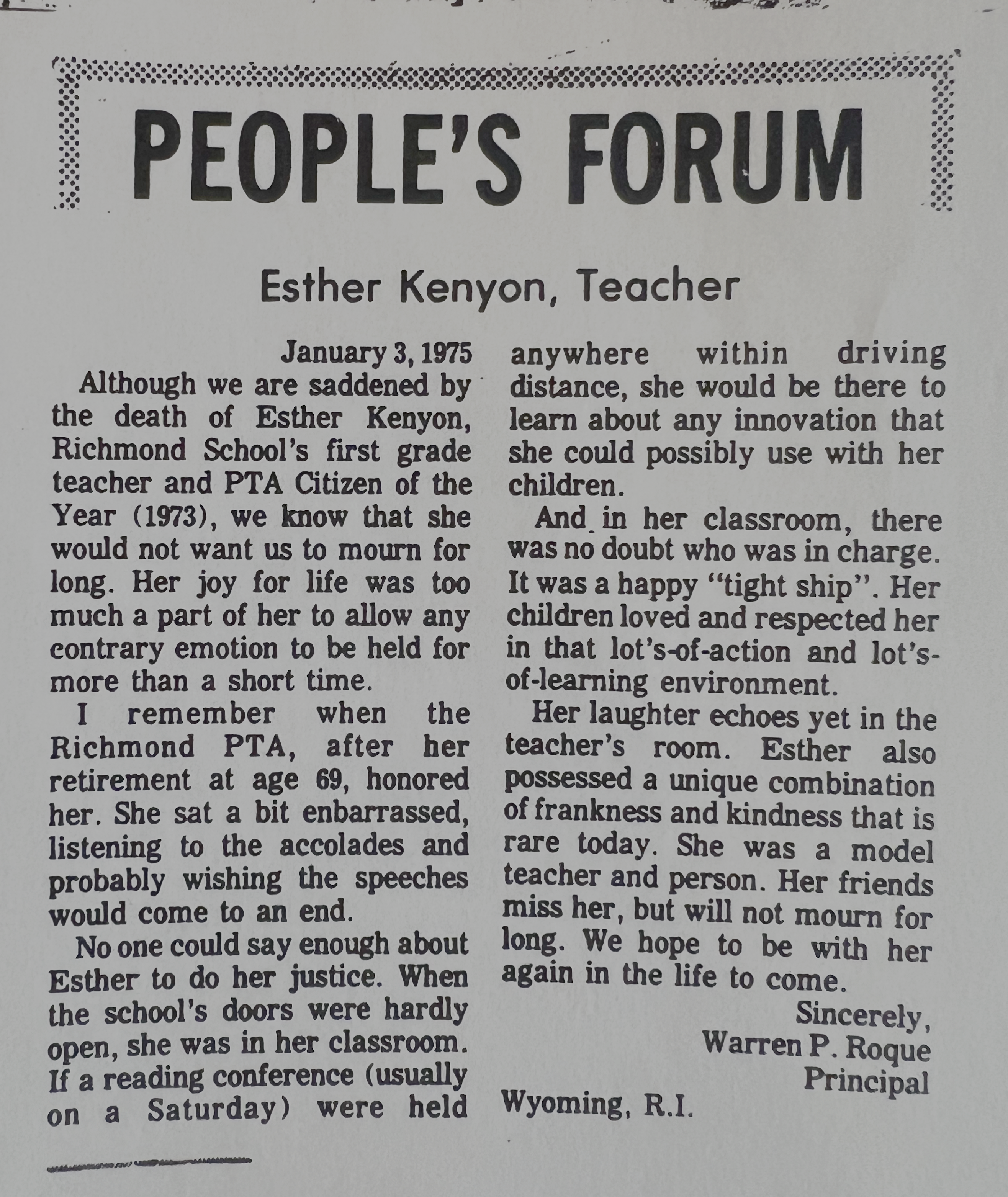
ESTHER was an elementary school teacher in Richmond for the better part of 40 years. The 1935 Rhode Island census shows she was teaching at that time. She retired in 1971. Her children Judy, Carol, and Dick were born in the late 30s and early 40s but I have no information regarding time away from teaching during that timeframe, so I’m unable to tally her teaching years definitively.
I thought Esther was Gil’s fourth-grade teacher – does anyone else remember this? With a nod to the “tight ship” notion below, I seem to remember my dad saying it was the longest year of his life.
FRENCH-CANADIAN WOMEN IN OUR ANCESTRY
In a nutshell, most relevant to us — Jacques was looking for love, and fortunately, Jacques’ king had his back.
OK, I admit, that really doesn’t explain much at all. In fact, it probably only confuses things, but I couldn’t resist using it on this Valentine’s weekend. Here’s a better explanation for this grouping:
In the 17th century, King Louis XIV of France was facing a bit of a problem in his colony of New France (Canada): it had been determined that the colony faced the real danger of not being able to sustain itself — (initially population-wise). The ratio of unmarried men to unmarried women was wildly unbalanced with some estimates indicating the ratio being 12:1. The follow-on ramifications of this scenario were broad, but economic and defense impacts were at the fore. The solution: SEND WOMEN.
Send women they did. Between 1663 and 1673, King Louis XIV sponsored nearly 800 women in passage, dowries, and pre-marriage housing and care. The women arrived in New France with the specific intentions of arranging marriage contracts, securing a marriage, and… populating!
So, remember Jacques? Well, he was a real person, and he was fortunate enough to have one* of these women choose him for a husband. If your bloodline traces back through the Lussier/Cummiskey/Hillman line, you’re a descendent of King’s Daughter/Fille du roi CATHERINE Clerice and her husband Jacques Lussier. The couple married on October 12, 1671, in Québec.
Catherine arrived in Québec from St. Sulpice, Paris, Île-de-France, in August 1671.
Here’s the Jacques and Catherine family
lineage down to the Cummiskey/Hillman family:
GENERATION 01
Jacques and Catherine
married 12 October 1671
Québec
Jacques (b. 1646) and Catherine (b. 5 November 1653) had 13 children (very dedicated to improving those population numbers!**), among them was Christophe Lussier. I have seen his name recorded as both Christopher and Christophe.
**Couples producing 10 or more children received additional payment from the crown but It’s doubtful that Jacques and Catherine actually qualified for this payment as several of the children died in infancy.
GENERATION 02
Christophe(r) and Catherine
married 12 November 1696
Varennes
GENERATION 03
Jacques and Marie-Josephe
married 22 November 1723
Verchères
Christophe(r) Lussier
(b. 3 October 1673)
Catherine Gauithier
Among their children was a son, named Jacques after his grandfather.
Jacques Lussier
Marie-Josephe Labetolle
Among their children was a son, named… you guessed it… Jacques.
GENERATION 04
Jacques and Madeleine
married 29 January 1759
St. Sulpice
Jacques Lussier
Madeleine Chagnon
Among their children was a son, Alexandre Noel Lussier.
GENERATION 05
Alexandre and Marguerite
married 25 November 1793
St. Charles Richelieau
Alexandre Noel Lussier
Marguerite Martec
Among their children was a son, Francois Lussier.
GENERATION 06
Francois and Lucie
married 8 October 1833
St. Jean Baptise
Francois Lussier
Lucie Duchesneau
Among their children was a son, also named Francois Lussier.
GENERATION 07
Francois and Anastasie
married 18 May 1868
Roxton Falls, Shefford, Quebec
This Francois Lussier married
Anastasie Bachand.
The couple had one son, Mathias Lussier.
GENERATION 08
Mathias and Leontine
married 1893
Ware, MA
Mathias Lussier
(b. 12 February 1870)
Leontine Ouellet
(b. 8 December 1871)
Leontine’s maiden name appears in documents with many of the combinations/permutations of double/single Ls and double/single Ts. The first letter is sometimes recorded as Q and on at least one occasion, her name appears as “Willet.”
Mathias and Leontine’s fifth child was daughter Florina Marie (or Marie Florina, it depends on which document you happen to find).
GENERATION 09
Florina and Francis
married 29 November 1921
North Kingstown, RI
Florina Lussier
(b. 5 May 1903)
Francis Cummiskey
(b. 19 September 1899)
The couple had 9 children, the eldest of which was a daughter, Claire Cummiskey.
GENERATION 10
Claire and Gilbert
married 30 June 1948
North Kingstown, RI
Claire Cummiskey married Gilbert Hillman in 1948; they had 10 children.
You can fill in the rest…
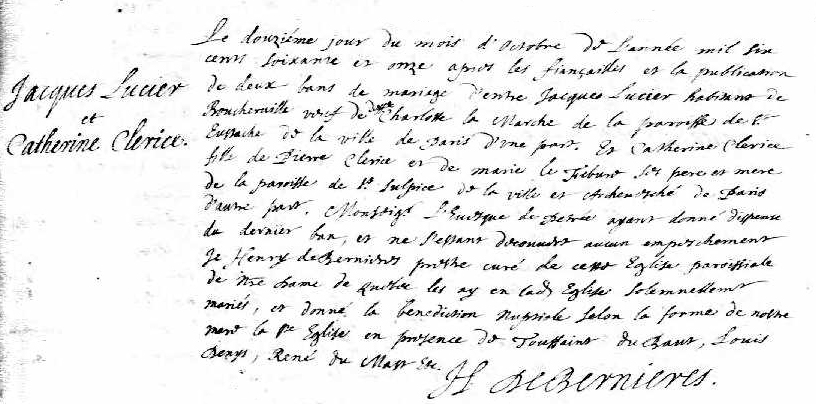
CHURCH MARRIAGE RECORD OF JACQUES LUCIER (LUSSIER)
AND CATHERINE CLERICE – NOTRE-DAME, QUEBEC, 1671.
I’M UNSURE WHEN THE SPELLING OF “LUCIER” CHANGED TO “LUSSIER”
I had never heard of the King’s Daughters/Filles du roi until last year, or if I had, I did not know of any connection/lineage. I was astounded when Michaela provided me details. In addition, Michaela indicated she had learned of the Filles du roi in a high school history class. I know this never came up in any high school history class I attended. I have a 1989 family genealogy report compiled by a descendant of one of Flo’s brothers and while Catherine Clerice and Jacques Lussier are included, there is no mention of Catherine being a King’s Daughter.
I have a couple thoughts on this: one, the advent of the internet really opened up the ability to do genealogical research; the 1989 compilation was done within a much more restrictive research and access environment. La Societe des Filles du roi has a website serving as a portal to a wealth of resources and information but it did not come into existence until 1994. Second, for many years the prevailing notion was that these women were of questionable reputation, so omission of affiliation with the Filles du roi (if known) may have been intentional.
Recent research leans towards debunking that particular myth. In fact, the crown’s vetting included, at the very least, testimony of virtue from local parish clergy. In addition to evaluation of virtue, general health assessments were done with a focus on the probability of surviving the weeks of sea voyage required to reach New France as well as the candidate’s ability to withstand the tough farming lifestyle and harsh climate Québec held in store.
Most of the women had never been married, some were orphans, others came from families with daughters “to spare” – lessening that family’s financial burden. Though fewer in number, there were some widows among the Filles du roi, they traveled either alone or with children in tow. Women considered to be of higher societal standing often matched with military or government officials. The women ranged in age (according to one source) from 12 to 25. I haven’t read anything that indicates women traveled to New France without their own consent, but I have to believe some went as a last resort and honestly, that age range includes a lot of “women” that were still children. I will add that I did find another source that lists the age range to be between 16 and 40 — so while the actual range remains unclear, it’s probably safe to assume it was wide. Records show that Catherine Clerice was 18 when she married.
The French crown paid the travel fare for each of the women, and each arrived with a crown-sponsored dowry comprised of either cash, a trousseau of clothing and linens, or livestock, or some combination of the three. The value of the dowry varied based on birth status. I’ve read conflicting information on what this range was but La Societe des Filles du roi website indicates the range to be between 50 and 100 livres/pounds.
Perhaps the discrepancy I see is due to comparing coin value and collective (total) value: France had a vested interest in increasing the population but also didn’t want to deplete cash/coin reserves on dowries. Instead, as indicated earlier, dowries were often a combination of coin, trousseau, and livestock, the latter two options being less of a cash outlay for the crown. Also worth noting; the program was in place for ten years, so economic factors would have to be considered fluid. I’ve read that at some point during this time, the livre in New France was worth roughly half that of its value in (old) France. Any formula for dowry computation and distribution gets muddled quickly between the various sources and possible formulation factors.
Despite the murkiness of actual numbers, the bottom line is that these dowries were substantial with at least one website indicating the value equating that of a laborer’s yearly earnings. The same website establishes the buying power of the livre at the time; 50 livres would get you a cow, 500 livres would buy you 20 acres of farmland.
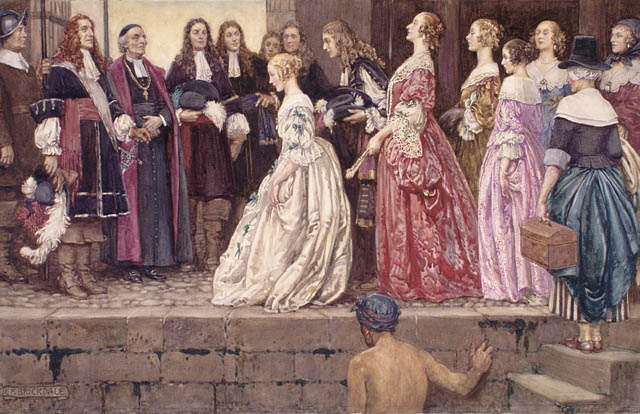
WATERCOLOR BY ELEANOR FORTESCUE-BRICKDALE, 1667 (LIBRARY AND ARCHIVES CANADA) – TWO OF THE MEN ARE IDENTIFIED AS LEADERS OF THE colony. NONE OF THE WOMEN ARE SPECIFICALLY IDENTIFIED. WHILE EXPERTLY CRAFTED, THE PAINTING HAS BEEN CRITICIZED AS BEING AN OVERLY ROMANTICIZED DEPICTION OF AN ARRIVAL SCENE.
I mention that some women probably opted to go to New France as a last resort, but it is also true that the women, once safely arrived in Québec, enjoyed advantages that would have been unusual for women of that time. Marriage contracts protected the women from the sudden or untimely death of a suitor and the women were allowed to break contracts should they have a change of heart regarding a choice in a husband – in essence, the bride picked the groom. That Farmer in the Dell song I sang as a kid clearly wasn’t the French-Canadian version. Additionally, the prospect of a women’s dowry often led to farmers dedicating time and resources to property improvements in hopes of increasing their value in the marriage market.
It is understood that while these women left France facing many unknowns and perils, they were going to what France considered to be their own territory, so cultural and language barriers were reduced. Moreover, chances of a sustainable future were improved — better than what staying in France apparently held. However, I remain fascinated by the give and take dynamics of the dowry values and property values of the women and men respectively as well as the range of potential challenges and outcomes these women experienced.
This has been a long post and thus far you’ve read a lot about these women in general and about the family lineage going back to Jacques Lussier and Catherine Clerice but remember there are four names in the group. Note that I placed generation numbers in the lineage text: going back to Generation 4 you’ll find one of the many Jacques Lussiers and his wife Madeleine Chagnon. Madeleine was the great-granddaughter of Fille du roi CATHERINE Pratte. (Apologies for the boxes in this section not lining up – I tried everything I could to get them to, but nothing seemed to make them stick).
There is a similar tie-back in Generation 2 — Christophe Lussier and Catherine Gauithier. Catherine was the granddaughter of MARIE Francoise Pomponnelle, but Marie was not a Fille du roi. So why is she included here? Marie belongs to another group of women that generally pre-date the Filles du roi in their arrival in New France. This group is known as the Filles à marier or “girls to marry.” The major difference between the Filles à marier and the Filles du roi groups is that the former group came about as a result of grassroots efforts, if you will, characterized by sponsorship by individuals or small organizations to bring women to New France to be wedded (very much a mail-order bride vibe to me — even more so than the Filles du roi). These women did not have the luxuries or advantages of sponsorship of the king. If they were lucky, their passage was paid for, but they had no crown-sponsored dowries and marriage contracts were usually signed before leaving France. If there was no marriage contract in place, the women were signed on as servants for a number of years with the expectation that marriage would follow the completion of that contracted time.
*So that’s three names for the grouping of four — to complete the grouping, I will tell you that Jacques was actually fortunate enough to have TWO women chose him as husband. Catherine Clerice was his second wife. His first wife, CHARLOTTE De La Marche, has also been identified as a Fille du roi. Sadly, she died a few weeks after giving birth in 1671. Charlotte has no bloodline connection to us, but I feel she is part of our story, so I wanted to honor her memory by including her here. Charlotte’s child survived — a daughter named Marie, who soon became Catherine Clerice’s stepdaughter.
Here are a few websites I’ve looked at while learning about these women. Some take a seriously deep dive into the numbers. I think this information would make an interesting data visualization project.
https://www.thecanadianencyclopedia.ca/fr/article/filles-du-roi
I particularly enjoyed the paragraph here dedicated to the box
of personal accessories provided upon departure from France.
https://www.tfcg.ca/filles-du-roi
YOUTUBE VIDEO DEDICATED TO FILLE DU ROI CATHERINE CLERICE
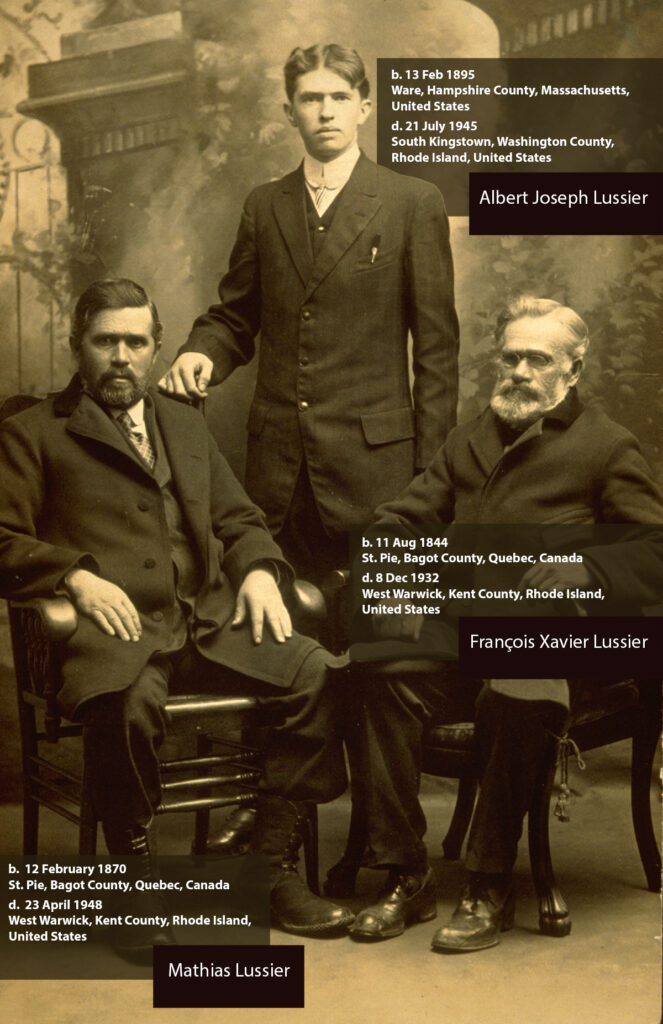
Mathias Lussier (seated on the left) is the last Lussier in our Filles du roi/Filles à marier bloodline before the switch to Cummiskey/Hillman/etc. He was born in Canada in 1870, moved to Ware, MA sometime around 1887 and eventually made the move to Rhode Island around 1900/01 (1900 census records him in Ware, MA — daughter Eva was born in West Warwick, RI in 1901). He had just one sibling, a half-sister, Rosanna Lussier. Mathias died in 1948.
So, there you go — to recap: CATHERINE Clerice, MARIE Francoise Pomponnelle, CATHERINE Pratte, and CHARLOTTE De La Marche are four women identified as Filles du roi/Filles à marier with connection to the Lussier/Cummiskey/Hillman lineage.
13 responses to “February 15, 2025 – Puzzle Discussion”
Whew! That’s a lot!
I promise not as much reading next week.
A lot of research Nancy! Pretty interesting! Did not realize anyone had that much info going that far back.
Michaela knew – not me
The Filles du roi Society offers membership – part of which includes them verifying lineage for you. I’m considering it because with everyone being named Jacques or Francois or Catherine or Marie something and all the variations on the spelling of names I think it would be easy to get wires crossed and ultimately find out we took a wrong turn at generation “fill in number here” — and we’re not connected at all.
But… the line does seem solid. I zigged and zagged back from wives of the Lussiers and many of the lines don’t trace back that far – meaning others in the Lussier line have dug up records that support the line as I presented it.
Back to getting 0 connections. LOL – I had a good 2 week run there!
So much cool info! Thanks Nancy!
Was Esther Grandpa’s aunt?
And I did indeed consider the name Phoebe for Megan but I was afraid people would always spell is wrong. Funny now, so many people put an H in Megan!
And Lott Knott is funny! She could’ve been a newscaster alongside Mario!
Esther is Grandpa’s mom.
OMG – Lott Knott and Mario Hilario, a news team you can trust.
Sarah, all the ways Megan gets elongated drive Meg crazy. When someone will ask her how to spell it they’re always mildly surprised that it’s just simply Megan, no added h or e or a.
Totally! As in weird places and always the H!
Like just regular M-E-G-A-N! It’s not hard!
I got two but that was after going in and out multiple times! Trust me the two I got were by trial and error. Working off of a thought I’d get “one away” and work off that. Can’t believe I didn’t figure out the teachers or the CvS ones. Duh!
Yes, I thought someone might get the CvS group at least. I admit, the others are difficult.
Hey – Karen sent me the photo of dad (Gil) in his bellhop uniform. I’m going to go into last week’s posting and add it there. I’ll do this later today.
Didn’t get this week’s. Was very close on one after refreshing the screen multiply times. Finally lost track of my guesses and used the last guess.
Bill, that’s what I did, forgot my number of guesses and lost. But honestly I didn’t really get any of them, I did it strictly on guess and elimination. I had gotten 2 and was on the third when I miss counted my guesses.
I had a couple good weeks. This was not one.
I had forgotten the names of CVS movie characters. Was not thinking about that connection at all.
Yes, Michael would have been Mary. I like the name.
Cat sleeping on the pile of papers, LOL!